International Student Transfer to US Universities: A Step-by-Step Guide

An international student transfer to US universities normally runs on two parallel tracks: the academic track, where you complete about 60 transferable units and your major preparation at a community college, and the immigration track, where your F-1 record moves to the new school in SEVIS. Both have fixed deadlines, and missing either one costs a full year. Harvest College Prep guides students through both at the same time.
The transfer route is not a fallback. For families comparing the cost of four years at a private US university against two years at a community college followed by two at a top public, it is often the better decision on academics and on money. What makes it feel risky for international students is the extra layer: credit evaluation, English proficiency rules, and a visa record that has to be released and reissued on schedule.
Here is the sequence, in order.
What Are the Eligibility Requirements for an International Transfer Applicant?
The academic requirements are the same ones domestic transfer applicants face, with two differences that matter.
- Unit count. Junior-level transfer into the UC system means roughly 60 semester units of transferable coursework completed by the end of the spring before you enroll. Units earned in remedial English or math, and most physical education, do not count toward that total.
- The non-resident minimum GPA. UC publishes a higher minimum grade point average for non-resident applicants than for California residents, and international students fall in the non-resident group. The minimum only makes an application eligible for reading; admitted students at the most selective campuses sit well above it. Our breakdown of UC transfer requirements covers the patterns in detail.
- Major preparation. This is where files are actually won or lost. Each campus and major publishes a required set of preparatory courses, and for a California community college student the authoritative map is ASSIST.org. Verify every course against your target campus and major before you enroll in it.
- A general education pattern. IGETC is the shared pattern accepted across UC and CSU. Private universities such as USC run their own requirements instead, which means a schedule optimized for one system can leave gaps in the other.
- Transferable, not just accredited. The community college must be SEVP-certified for you to hold F-1 status there, and the individual courses must be UC-transferable for them to count. Those are two separate checks.
How Do Credits From a School Outside the US Get Evaluated?
Carefully, slowly, and usually for less credit than students expect.
If you studied at a secondary school or university outside the US, expect to provide official transcripts, certified English translations, and in many cases a course-by-course credential evaluation from a recognized agency. Universities then decide three things separately: whether the coursework carries unit credit, whether it satisfies a general education requirement, and whether it satisfies major preparation. A course can clear the first and fail the other two.
Two practical consequences:
- Start the evaluation early. Requesting documents from an overseas registrar and having them translated regularly takes months, not weeks, and the file cannot be read without them.
- Do not build a two-year plan around an assumed equivalency. If a required calculus or economics course might be satisfied by prior study, get that confirmed in writing before you skip it. If confirmation does not arrive in time, take the course. A duplicated course costs one term; a missing prerequisite costs a cycle.
Students who have already completed university coursework abroad should also be honest about which admission category fits them. Some are better served applying as transfer students, others as freshman applicants. Our comparison of transfer versus freshman admission walks through how the odds and the requirements differ.
How Does the F-1 Visa Transfer Between Schools Actually Work?
It is a SEVIS record transfer, not a new visa application, and it is driven by two dates.
The steps, in the order they happen:
- Get admitted and accept the offer. The new university cannot issue an I-20 before you have an admission decision and, typically, proof of funding for the coming year.
- Request the transfer with both DSOs. You tell your community college's Designated School Official which school you are moving to and agree on a SEVIS release date, usually near the end of your final term.
- The record releases on that date. After it releases, the new school controls your record and issues its I-20. Your SEVIS ID normally stays the same, and the SEVIS fee is not paid again.
- Report and enroll on time. You must enroll in the next available term at the new school, and the gap between programs is limited, so a student who releases in June and plans to start the following spring is putting their status at risk.
- Travel on the correct document. If you leave the US after the transfer, re-enter on the new school's I-20 with a valid travel signature. A visa stamp that still shows the old school is generally fine as long as the category and dates are valid, but carry the current I-20.
Two rules apply throughout, not just at transfer time: maintain a full course of study every term, and remember that only a limited amount of online coursework counts toward full-time enrollment. A student who drops below full-time without prior authorization can jeopardize their status and, with it, the transfer.
What Does the Filing Calendar Look Like?
Three separate clocks run at once, and none of them wait.
- Fall of your second year: the UC application filing window opens and closes in November. One application covers multiple campuses.
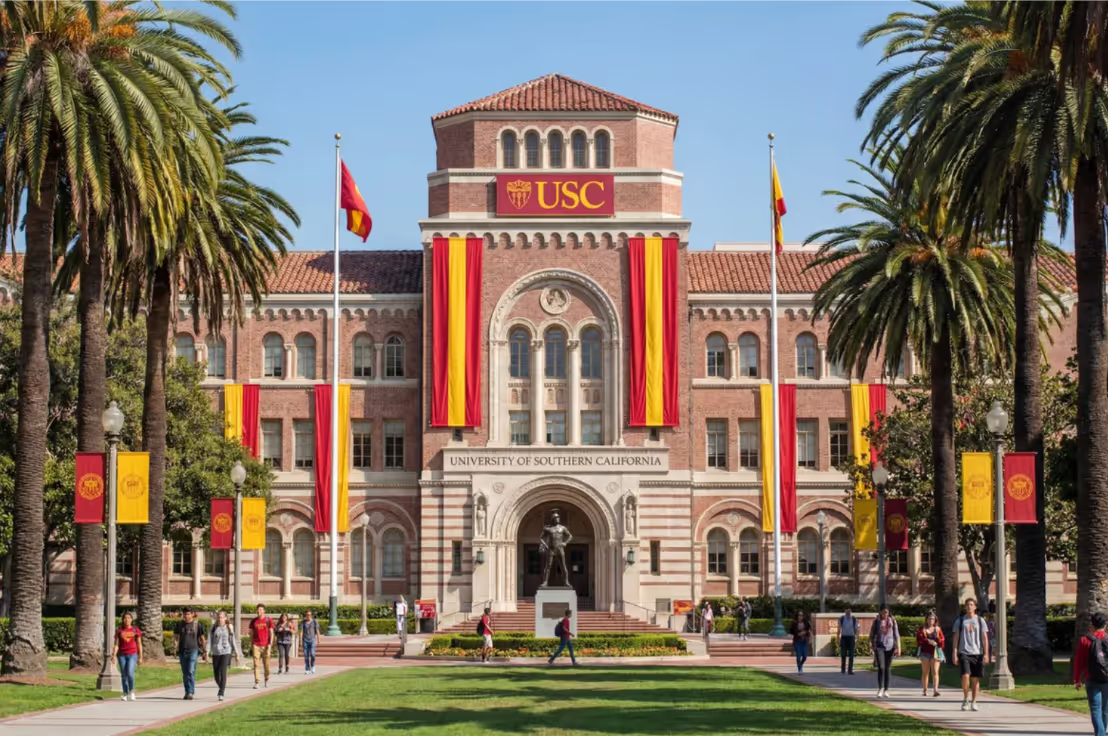
- Late winter: private university deadlines arrive on their own schedule; USC's transfer deadline is February 1, and each school sets its own document requirements including instructor recommendations.
- Spring: admission offers are conditional. Every promised course must be completed with the required grade, transcripts must be sent by the stated deadline, and only then does the I-20 process finish.
- Summer: SEVIS release, new I-20, housing, and orientation.
For international families the immigration calendar has to sit on the same page as the academic one. That single planning document, maintained from the first semester rather than the last, is the most reliable predictor of a clean transfer that we see.
Getting the Two Tracks to Line Up
The students who transfer smoothly are not the ones with the highest grade point averages. They are the ones who verified each course before enrolling, started their credit evaluation early, and treated the visa transfer as a scheduled task rather than a summer emergency.
With 15 years of experience, more than 1,000 successful admissions, and a strong track record of placements into top-25 universities, Harvest College Prep works with international and Korean-American families from both our US and Seoul offices, which means the academic plan and the paperwork get built together. See how families use that support on our transfer admissions page, review real outcomes in our student outcomes, or book a consultation before your next registration window.
Frequently Asked Questions
Can an international student transfer to a US university from a community college?
Yes, and it is one of the most common routes into selective US campuses. A student completes roughly two years of transferable coursework at a SEVP-certified community college, meets the unit and major preparation requirements of the target university, and applies as a junior-level transfer. The immigration side is a school transfer within the same F-1 status, not a new visa category.
What GPA does an international student need to transfer to a UC?
The published minimum for non-resident applicants, which includes international students, is higher than the resident minimum, and admitted students at Berkeley and UCLA are typically far above either figure. Treat the published number as a floor for eligibility, not a target, and plan around completed major preparation with a strong upward trend.
Do credits from a university in my home country transfer to a US university?
Sometimes, and rarely at full value. Coursework from an accredited overseas institution is evaluated case by case, often requires a course-by-course credential evaluation and translated transcripts, and may be granted unit credit without satisfying a specific major requirement. Never assume an equivalency before it is confirmed in writing.
Do I still need TOEFL or IELTS if I studied at a US community college?
It depends on the campus. Many universities waive the English proficiency test once an applicant has completed transferable English composition coursework in the US with a strong grade, but the waiver conditions differ by school and change between cycles, so confirm each campus's current policy before skipping the test.
How long does the transfer take from start to finish?
Two academic years of community college coursework is the standard plan, with the application filed in the fall of the second year and enrollment beginning the following fall. Students who arrive needing English or math preparation, or who enter an impacted major with a long prerequisite chain, should plan for an extra term rather than compressing the sequence.