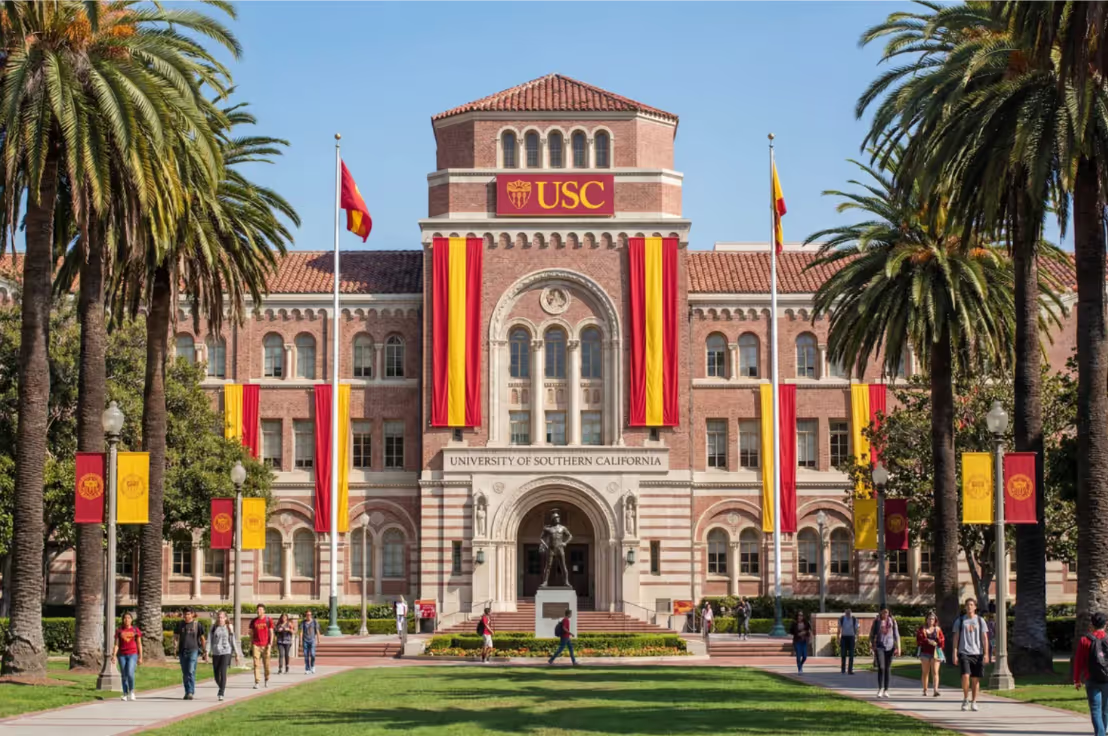
The core USC transfer requirements are straightforward on paper: at least 30 transferable semester units, a minimum college GPA of about 3.0 with admitted students typically near 3.7 or higher, completion of writing and math prerequisites, and a February 1 application deadline for fall entry. Harvest College Prep explains what those requirements really demand, and where transfer applicants to USC most often lose the offer.
USC is one of the most transfer-friendly selective private universities in the country. It admits a large transfer class every year and evaluates those students on what they have done in college rather than what they did at seventeen. That is genuinely good news. It also means USC is reading your file differently than a UC campus does, and preparing for one does not automatically prepare you for the other.
What Are the Minimum USC Transfer Requirements?
Start with the eligibility bar, then plan well past it.
- 30 transferable semester units. This is the threshold that defines you as a transfer applicant. Below 30, USC folds your high school record back into the review.
- A minimum GPA around 3.0. This is the published floor. Admitted students routinely present far more.
- A writing requirement. USC expects college-level writing coursework, generally the equivalent of its own first-year writing sequence, completed before enrollment.
- A math requirement. Most applicants need college algebra or higher, with the specific course depending on the intended major.
- Major prerequisites. Business, engineering, cinematic arts, and the sciences each carry their own required coursework, and several also require a portfolio, resume, or supplemental materials.
The distinction that matters: meeting these makes your application complete, not competitive. USC does not admit to a formula, so a file that clears every minimum and nothing more is a weak file.
What GPA Do You Actually Need to Transfer to USC?
The honest range for admitted transfer students sits around 3.7 and above, and impacted programs push higher. Marshall business, Viterbi engineering, and the arts schools all draw applicant pools where a high-3 GPA is the norm rather than the exception.
Two things soften that picture in a way pure numbers miss.
First, USC reads the transcript rather than just the average. A student who started at 3.3, corrected course, and finished with two 4.0 semesters in serious major coursework tells a story that a flat 3.6 does not. Upward trajectory is real currency in holistic review.
Second, rigor counts. A 3.8 built from the required calculus, physics, and economics sequence outranks a 3.9 assembled from whatever was easiest to schedule. Admissions readers know which courses are hard at your college, and they can see when a prerequisite has been deferred indefinitely.
Where the GPA question gets genuinely difficult is in balancing it against completion. Dropping a required course to protect an average frequently costs more than the tenth of a point it saves, a tradeoff we work through with students in our transfer admissions planning.
How Is the USC Transfer Review Different From UC?
This is the part California community college students most often get wrong, and it is the difference between one strong application and two.
USC does not use IGETC. As a private university it maintains its own general education pattern and its own Transfer Credit Guide, which lists how courses from your specific college map onto USC requirements. A student who plans a schedule purely around IGETC completion can arrive at February 1 with USC general education gaps that no amount of GPA repairs.
USC review is holistic; UC review is largely structured. UC campuses lean on GPA, verified major preparation, and completed requirements. USC additionally weighs:
- A college instructor recommendation, which UC does not request at all.
- Your reason for transferring, stated clearly and specifically, ideally about what USC offers that your current institution cannot.
- What you did outside class during your college years, including work, research, and leadership.
- Fit with the particular school within USC, since you apply to a school and not just the university.
The deadlines differ too. USC's transfer deadline is February 1 for fall entry, while UC applications close in the preceding fall. Running both tracks means two separate calendars and two different course plans held simultaneously. That dual-track planning is exactly the situation our student outcomes tend to come out of.
What Is the Right Strategy for a USC Transfer Application?
Treat the application as a case you are building rather than a form you are completing.
- Map coursework against the USC Transfer Credit Guide early. Look up your college by name and confirm which of your courses transfer and what they satisfy. Do this in your first year, not your last.
- Finish the writing and math requirements ahead of schedule. These are the two most common outstanding items on otherwise strong files.
- Build a relationship with at least one college instructor. You will need a recommendation from someone who can speak to your work in a college classroom, and that takes a semester of visible effort, not an email in January.
- Answer the transfer question directly. Name the program, the faculty, the resources. A generic statement about wanting a better school reads as a student running from somewhere rather than toward USC.
- Keep spring strong. USC offers are conditional on final coursework. A weak final term can undo the admission.
- Apply to USC and UC as one coordinated plan. Because the requirement sets differ, sequencing courses so a single schedule serves both is a planning problem worth solving deliberately, and it is very hard to fix retroactively.
Making the USC Case for Yourself
USC rewards students who used community college seriously and can explain why the next two years belong at USC specifically. The requirements get you into the pool. The transcript trajectory, the completed prerequisites on USC's own terms, and a specific, credible reason for transferring are what get you the offer.
With 15 years of experience, more than 1,000 successful admissions, and a strong track record of placements into top-25 universities across our US and Seoul offices, Harvest College Prep helps students run the USC and UC tracks together without sacrificing either. To map your own timeline, start with a consultation.
Frequently Asked Questions
What GPA do you need to transfer to USC?
USC states a minimum college GPA around 3.0, but admitted transfer students typically present something closer to 3.7 or above, and impacted programs in business, engineering, and cinematic arts run higher. Treat 3.0 as eligibility and the high-3 range as the competitive target, since USC reviews the transcript in context rather than against a fixed cutoff.
How many units do you need to transfer to USC?
You need at least 30 transferable semester units completed to apply as a transfer student. Applicants with fewer than 30 units are reviewed with their high school record and test scores included, which is why most students wait until they have a full year of strong college coursework before applying.
When is the USC transfer application deadline?
The main USC transfer deadline is February 1 for fall entry, with supporting materials such as the transfer credit report and college reports due around the same window. Some programs, particularly in the arts, set earlier portfolio deadlines, so confirm your specific school requirement before planning your timeline.
Does USC accept IGETC?
USC is a private university and does not use IGETC. It has its own general education pattern and reviews coursework through its Transfer Credit Guide, so California community college students who plan only around IGETC often find some requirements unmet. If you are applying to both USC and UC campuses, your course plan has to satisfy two different systems at once.
Is it easier to transfer to USC than to be admitted as a freshman?
USC's transfer admit rate is meaningfully higher than its freshman rate, and the university enrolls one of the largest transfer classes among private US institutions. That said, the review is fully holistic, so a strong college transcript, instructor recommendations, and a clear reason for transferring matter as much as the raw numbers.