Common Community College Transfer Mistakes (and How to Avoid Them)

The community college transfer mistakes that actually cost students admission are rarely dramatic: enrolling in courses that were never verified on ASSIST, deferring hard prerequisites to protect a GPA, missing the September TAG or November UC filing window, and treating the final spring semester as a formality. Harvest College Prep sees the same handful of errors every cycle, and nearly all of them are preventable a year or two before they matter.
The transfer pathway works. Students move from a California community college into UC Berkeley, UCLA, and USC every year for a fraction of the cost of four years at a private university. What makes the route feel risky is not the competition. It is that the mistakes are silent. Nothing warns you that a course will not count, and the transcript looks fine right up until an admissions reader disagrees.
Here are the errors that do the most damage, and what to do instead.
Which Course-Selection Mistakes Cost Students the Most?
Almost every serious transfer problem traces back to a course chosen without verification.
- Assuming a course transfers because it sounds right. Course titles are not equivalencies. The only authority for a California community college is ASSIST.org, which maps your specific college's courses to a specific campus and major. If it is not on ASSIST for your target, it does not count, whatever the catalog description suggests.
- Confusing three different questions. Every course should be checked against all three: does it transfer for units, does it satisfy general education, and does it satisfy major preparation? A course can pass the first and fail the other two. Students who check only transferability accumulate units that move them no closer to admission.
- Planning around the associate degree instead of the transfer. The two are related but not identical. Optimizing purely for the degree can leave major preparation short, and major preparation is what selective campuses weigh most.
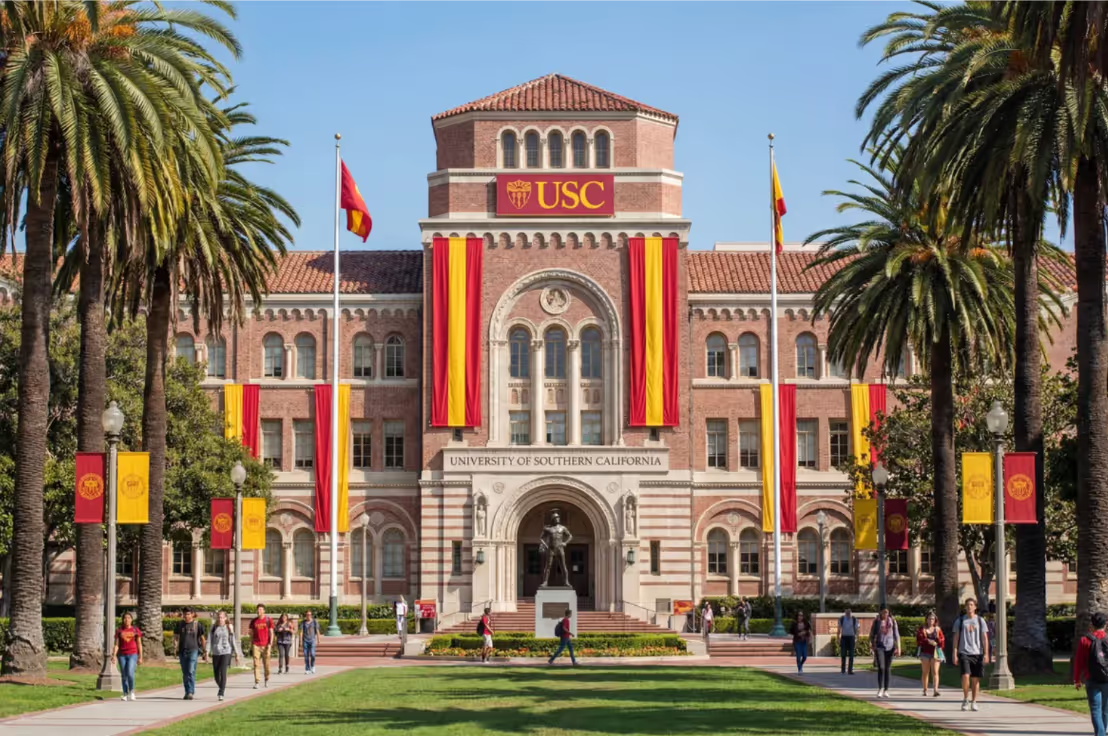
- Ignoring that requirements differ by campus. UC uses IGETC; USC and other private universities do not, and run their own general education patterns and credit guides. A schedule built for one system routinely leaves gaps in the other, as we explain in our guide to USC transfer requirements.
The fix is unglamorous and highly effective: before enrolling each term, verify every course on ASSIST against your target campus and major, and keep a written plan showing which requirement each course satisfies.
Why Does Protecting Your GPA Sometimes Hurt You?
Because a transfer file is read as GPA and rigor and completion, and students routinely trade the last two for the first.
The pattern is familiar. A student is nervous about calculus or organic chemistry, so it gets pushed to next semester, then the semester after. The GPA looks strong. Then the application asks whether major preparation is complete, and the answer is no. In practice a 3.6 with finished prerequisites frequently outperforms a 3.9 with two required courses outstanding, particularly at UC campuses where completed major preparation is close to a threshold condition.
Related versions of the same error:
- Repeating courses to erase grades. Some TAG agreements limit attempts, and heavy repetition is visible in review.
- Overloading to finish early. Compressing a five-course sequence into two terms produces the weak grades it was meant to avoid.
- Withdrawing habitually. A transcript with several withdrawals invites the question of whether the student can carry a full load at a selective university.
Difficulty sequenced sensibly over four or five terms beats difficulty avoided. Building that sequence is the core of what we do in our transfer admissions work.
What Deadline and Application Mistakes Are Unrecoverable?
Coursework problems often have a workaround. Calendar problems usually do not.
- Missing the September TAG window. The Transfer Admission Guarantee is filed in September, before and separately from the UC application. There is no makeup period, and a guarantee left unfiled is simply gone for that cycle. Our breakdown of how UC TAG works covers the terms.
- Treating the UC and USC calendars as one deadline. UC applications close in the fall; USC's transfer deadline is February 1. Two systems, two timelines, two sets of materials.
- Filing a TAG and then breaking it. The guarantee holds only if every promised course is completed with the required grade. Dropping one in spring voids it entirely.
- Underwriting the personal insight questions. Transfer essays are frequently drafted in the final week. For holistic reviewers they carry real weight, especially the question of why you are transferring.
- Skipping the recommendation groundwork. USC expects a college instructor recommendation. That relationship needs a semester of visible effort, not a January email to someone who barely knows you.
How Do You Avoid Repeating the Same Errors?
Every one of these has the same root cause: planning that starts in the second year rather than the first. Prerequisite chains in engineering, computer science, and the sciences run four or five terms deep, so a student who begins mapping in year two has already lost the flexibility to fix anything.
A workable system looks like this:
- Write the full two-year plan in your first semester, term by term, with each course tied to a requirement it satisfies.
- Re-verify on ASSIST every term, because articulation agreements change between cycles.
- Keep a second target campus with an overlapping course plan, so one impacted major does not become a single point of failure.
- Track the calendar separately from the coursework, with September, November, and February marked a year in advance.
- Protect the final spring. Offers are conditional and rescissions are real.
Families who want to see how the finished version looks can review our student outcomes.
Planning Out the Mistakes Before They Happen
None of these errors comes from a lack of effort. They come from a system where the consequences of a small choice show up two years later, with no warning in between. The students who transfer cleanly are the ones who made the plan visible early and checked it every term.
With 15 years of experience, more than 1,000 successful admissions, and a strong track record of placements into top-25 universities across our US and Seoul offices, Harvest College Prep builds those plans with students from the first semester forward. If you want yours reviewed before the next registration window, start with a consultation.
Frequently Asked Questions
What is the most common community college transfer mistake?
Taking courses that do not transfer or do not satisfy major preparation for the target campus. Because the credits still appear on the transcript and still count toward an associate degree, the problem stays invisible until an application is reviewed, and by then the lost semester cannot be recovered. Verifying every course on ASSIST.org before enrolling prevents almost all of it.
Do all community college credits transfer to a UC?
No. Only UC-transferable courses count, and transferability is separate from whether a course satisfies your major preparation or general education pattern. A course can transfer for units, do nothing for your major, and still leave a requirement unmet, which is why students check three things per course rather than one.
Is it a mistake to take a lighter course load to protect my GPA?
Often, yes. Admissions readers evaluate rigor alongside the average, and deferring required math or science courses to keep a GPA high tends to backfire when those prerequisites are still unfinished at application time. A slightly lower GPA with completed major preparation is generally the stronger file.
How early should transfer planning start?
From the first semester of community college. Major preparation sequences in engineering, computer science, and the sciences can take four or five terms with prerequisites stacked in order, so a student who starts planning in their second year frequently cannot finish on time without adding a third year.
Can I fix a transfer mistake after it happens?
Some, but not all. A missing course can sometimes be completed in summer or through a second institution, and a weak semester can be offset by a strong upward trend. A missed application deadline or a forfeited Transfer Admission Guarantee generally cannot be recovered, which is why the calendar deserves as much attention as the coursework.