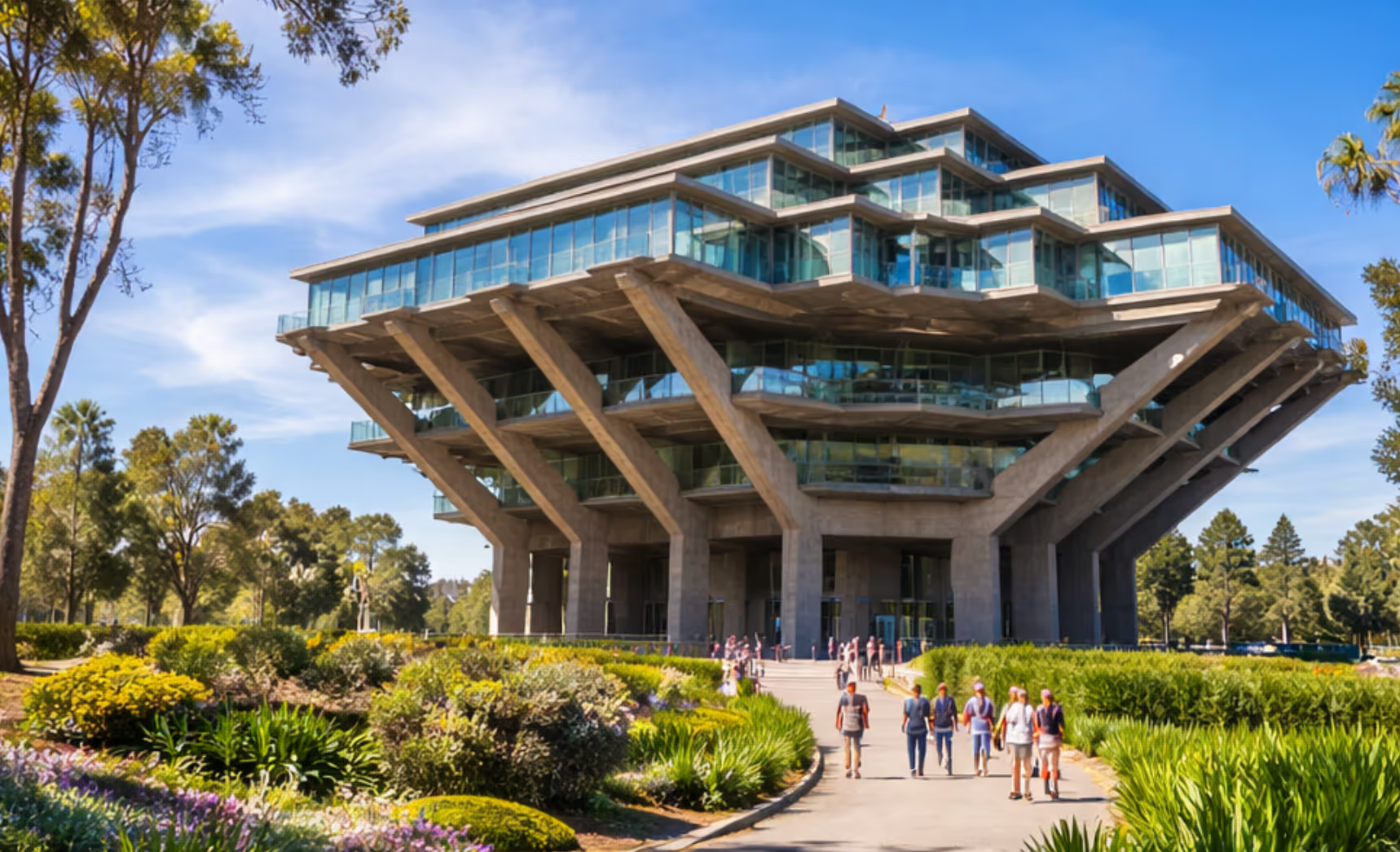
The short answer on how to transfer to UCSD from a California community college: complete 60 UC-transferable semester units by the end of spring, satisfy the seven-course breadth pattern, finish the major preparation your intended department requires, and apply inside the November University of California window. UC San Diego does not run a Transfer Admission Guarantee, so the plan has to be built on the coursework itself. Harvest College Prep sets out each piece below.
UC San Diego sits in an awkward spot in most students' plans. It is as selective as the campuses that families name first, but it lacks the guarantee program that makes Irvine or Davis feel plannable. That combination is exactly why the course map matters more here, not less.
What Are the Actual Requirements to Transfer to UC San Diego?
Four things, and all of them are verifiable long before you apply.
- 60 UC-transferable semester units (90 quarter units), completed by the end of the spring term before fall enrollment. This is the systemwide junior-standing requirement.
- The seven-course breadth pattern: two transferable college courses in English composition, one in mathematical concepts and quantitative reasoning, and four more from at least two additional subject areas.
- Major preparation for the departments that require it. UC San Diego publishes which departments carry required preparation, and for those the coursework has to be complete by the end of spring, not in progress into the summer.
- A transferable grade point average above the systemwide minimum of 2.4 for California residents and 2.8 for non-residents, understood as eligibility rather than as a target at a campus this selective.
The requirement that quietly sinks applications is the third one. A student with 60 units, the breadth pattern finished and two missing major preparation courses is not a slightly weaker applicant to a department that requires them; the file is evaluated against a preparation standard it does not meet. Verify every course against the articulation agreements each term, which is the process we walk through in our guide to using ASSIST.org.
Why Does UC San Diego Have No TAG, and What Replaces It?
Because it is one of the three campuses that sit outside the program.
Six University of California undergraduate campuses offer a Transfer Admission Guarantee: Davis, Irvine, Merced, Riverside, Santa Barbara and Santa Cruz. UC Berkeley, UCLA and UC San Diego do not. There is no version of a TAG that applies to UC San Diego, and no amount of preparation converts the standard review into a guarantee.
Two practical consequences follow.
First, the campus list has to be built deliberately. A realistic plan pairs UC San Diego with at least one participating campus where a guarantee is genuinely attainable, so the outcome does not rest entirely on discretionary review. Our explanation of how UC TAG works covers the thresholds and the September filing window.
Second, the preparation has to carry the file. Without a guarantee to fall back on, what remains is the strength and completeness of the transferable record: major preparation finished on schedule, grades in those courses, breadth complete, and a coherent academic direction. Note also that UC San Diego offers UniversityLink, an early commitment program for students at specific partner community colleges, with its own eligibility rules published by the campus. It is worth checking whether your college participates, but it applies only to those partner colleges.
How Should the Two Years Be Sequenced?
Backwards from the November application, term by term.
- First term. Choose the intended major and build the full two-year course map against the articulation agreements for UC San Diego and two or three additional campuses. Start the English composition sequence and the required math immediately, because both gate later courses.
- Second term. Continue the major preparation sequence in order. Re-verify articulation before the add deadline, since agreements are updated annually and a course that transferred last year may be listed differently this year.
- Third term. Confirm you are on track to reach 60 transferable units by spring and that every required major preparation course is either finished or scheduled. Draft the personal insight questions in this term, not in November.
- Fourth term, fall. File the University of California application within the November window. One application covers every campus you select, with the campus and major choices made inside it.
- Fifth term, winter and spring. Finish every course you reported as planned. Grades from this term are reported and conditions of admission are enforced against them.
- After the decision. Submit final transcripts by the stated deadline and complete enrollment steps for the college system UC San Diego assigns undergraduates to.
Two scheduling details cause most of the damage at this campus. Major preparation sequences frequently run in a fixed order across three or four terms, so a course missed in the first year cannot always be recovered in the second. And courses in the impacted preparation areas fill early at busy community colleges, which makes registration dates part of the academic plan rather than an administrative afterthought.
What Makes a UC San Diego Transfer File Competitive?
Completed preparation, strong grades inside it, and a major choice the record actually supports.
Transfer review at this level is largely a reading of coursework. A file that shows the required sequence finished on time, with strong grades in the courses the department cares about, is doing the thing the review is designed to detect. A file that shows scattered general education, a late-declared major and preparation still in progress is not, however well written the personal insight questions are.
That is also why the major selection deserves a real conversation. Applying to an impacted department with incomplete preparation is a materially different proposition from applying to a related department with the sequence finished, and students often discover the difference after the decision rather than before it. Our comparison of transfer admission rates across UC Berkeley, UCLA and USC gives useful context for how much the campus and major combination moves the odds.
Getting the Plan Right the First Time
Transferring to UC San Diego is a two-year coursework project with an application at the end of it, not an application with coursework behind it. The students who struggle are rarely the ones who worked less; they are the ones who verified the plan a year too late.
With 15 years of experience, more than 1,000 successful admissions, and a strong track record of placements into top-25 universities, Harvest College Prep builds and re-verifies these course maps term by term, working bilingually from our US and Seoul offices. Learn more about our transfer admissions service, read our success stories, or request a consultation.
Frequently Asked Questions
Does UC San Diego offer a TAG (Transfer Admission Guarantee)?
No. Six of the nine University of California undergraduate campuses offer a Transfer Admission Guarantee, and UC Berkeley, UCLA and UC San Diego are the three that do not. A student who wants a guarantee in the mix has to place it at one of the participating campuses while applying to UC San Diego on the standard competitive review.
How many units do I need to transfer to UC San Diego?
The University of California requires a minimum of 60 UC-transferable semester units, which is 90 quarter units, completed by the end of the spring term before fall enrollment. Units above the lower-division ceiling do not add credit, so taking substantially more than 60 units generally delays the transfer without improving the application.
Does UC San Diego require major preparation courses?
For a number of departments, yes, and the required preparation must be complete by the end of the spring term prior to fall admission. UC San Diego publishes the departments that carry required major preparation, which have included areas such as biology, chemistry and biochemistry, cognitive science, economics, engineering, mathematics, physics and psychology. Check the official admissions page for your intended major, because the list and the specific courses are revised.
What is the seven-course pattern and does UCSD use it?
The seven-course pattern is the University of California breadth requirement: two transferable college courses in English composition, one in mathematical concepts and quantitative reasoning, and four more drawn from at least two other subject areas. It is one of the paths to meeting the systemwide requirements, and it is considered in transfer review at UC San Diego alongside major preparation.
What GPA do admitted UC San Diego transfers have?
The systemwide minimum transferable grade point average is 2.4 for California residents and 2.8 for non-residents, and admitted UC San Diego transfers are typically well above that floor. UC San Diego is a selective campus and the effective range shifts by major, with the impacted departments expecting more, so the published minimum should be read as eligibility rather than as a target.